

Nail Polish Remover Pads vs. Liquid Nail Polish Remover: Which Product Is Better for Your Brand?
- Understanding the Core Differences Between Nail Polish Remover Pads and Liquid Removers
- What Nail Polish Remover Pads Actually Are
- How Liquid Nail Polish Remover Works and Why It Has Dominated the Market
- The Formulation Science Behind Each Format
- B2B Buyer Considerations: Retail Positioning, Margins, and Consumer Trends
- Where Each Format Wins on the Retail Shelf
- Margin Analysis and Cost of Goods Comparison
- Sustainability and Regulatory Trends Shaping Both Formats
- Head-to-Head Comparison: Nail Polish Remover Pads vs. Liquid Nail Polish Remover
- How ISAYNAIL Supports Brands Across the Full Nail Polish Product Ecosystem
- A Manufacturing Partner with Over a Decade of Proven Expertise
- A Product Portfolio Built for Today's Market Demands
- OEM/ODM Services That Give Brands Real Competitive Control
- Frequently Asked Questions
After more than 15 years of working directly with nail polish product manufacturers, private-label brands, and professional salon distributors, I can tell you with confidence that one of the most underestimated sourcing decisions a brand owner makes is choosing between nail polish remover pads and liquid nail polish remover. It sounds simple on the surface, but this single choice touches your packaging costs, your retail shelf appeal, your target demographic, your regulatory compliance burden, and ultimately ISAYNAIL's perceived value. I break down both formats with the depth and honesty that only comes from real industry experience, and I give you a clear framework for making the right call for your specific business model.
Understanding the Core Differences Between Nail Polish Remover Pads and Liquid Removers
What Nail Polish Remover Pads Actually Are
Nail polish remover pads are pre-saturated, single-use or multi-use wipes that combine an acetone or non-acetone solvent base with a fibrous substrate — typically cotton, non-woven fabric, or a blended material. The pad format delivers the solvent directly to the nail surface in a controlled, mess-free application. According to the U.S. Food and Drug Administration's cosmetics guidelines, these products fall under the same regulatory umbrella as liquid removers, but their delivery mechanism changes how brands must think about packaging, shelf life, and moisture retention. From a formulation standpoint, the challenge with pads is maintaining solvent saturation over the product's shelf life without the substrate drying out or degrading. I have personally reviewed dozens of pad formulations where brands underestimated the importance of the sealing mechanism in their foil or resealable pouch packaging, leading to dried-out pads that generated customer complaints and returns.
How Liquid Nail Polish Remover Works and Why It Has Dominated the Market
Liquid nail polish remover has been the industry standard for decades. It is typically dispensed via a bottle with a nozzle, pump, or open-pour cap, and applied using a cotton ball, pad, or reusable cloth. The liquid format allows for higher solvent concentration flexibility — brands can formulate anywhere from a gentle 10% acetone blend to a professional-grade 100% acetone product. The cosmetic ingredient safety data published by the Personal Care Products Council confirms that acetone, the most common active ingredient in both formats, is one of the most thoroughly reviewed cosmetic solvents in the industry. Liquid removers are cheaper to manufacture at scale, easier to fill on standard production lines, and have a longer proven shelf life when properly sealed. However, they require the end user to supply their own application material, which some modern consumers find inconvenient — and that inconvenience gap is exactly where nail polish remover pads have carved out significant market share.
The Formulation Science Behind Each Format
What most brand owners do not realize until they are deep into product development is that the formulation for a pad product cannot simply be poured into a substrate. The solvent-to-humectant ratio must be adjusted to account for substrate absorption, evaporation rate through the packaging, and skin contact time. I have seen brands attempt to saturate standard cotton pads with their existing liquid remover formula and wonder why the pads either over-saturate and leak or under-deliver on removal efficacy. Effective pad formulations typically incorporate conditioning agents such as aloe vera, vitamin E, or glycerin at higher concentrations than their liquid counterparts, because the extended skin contact time of a pad increases the potential for dryness and irritation. This is a non-trivial formulation investment that brands must budget for when evaluating the true cost of entering the pad format.
B2B Buyer Considerations: Retail Positioning, Margins, and Consumer Trends
Where Each Format Wins on the Retail Shelf
From a retail strategy perspective, nail polish remover pads consistently outperform liquid removers in travel retail, convenience store channels, and impulse-purchase end-cap displays. The compact, individually wrapped format communicates portability and hygiene — two values that have grown dramatically in importance since 2020. A Statista analysis of the global cosmetics and personal care market consistently shows that convenience-driven formats are gaining share across all personal care categories, and nail care is no exception. Liquid removers, on the other hand, still dominate the professional salon supply channel, the drugstore beauty aisle staple position, and the value-tier mass market. If ISAYNAIL is targeting professional nail technicians or cost-conscious everyday consumers buying in bulk, liquid remover remains the more defensible format. If you are building a High Quality, travel-friendly, or lifestyle-oriented nail brand, pads offer a stronger visual and experiential story.
Margin Analysis and Cost of Goods Comparison
I want to be direct here because I see too many brand owners make sourcing decisions based on unit cost alone without accounting for the full cost of goods. Nail polish remover pads carry a higher per-unit manufacturing cost than liquid remover due to the substrate material, the individual or multi-pack sealing process, and the more complex filling equipment required. However, pads also command a meaningfully higher retail price point. A 30-count pack of quality remover pads retails between $6 and $12 in most markets, while a comparable-volume liquid remover often retails between $3 and $7. The gross margin percentage can actually be superior for pads when the brand successfully communicates the added convenience and High Quality positioning. The key variable is minimum order quantity — pad production lines typically require higher MOQs than liquid filling lines, which means the format is better suited for brands that have already validated their market or are launching with a committed retail partner.
Sustainability and Regulatory Trends Shaping Both Formats
Sustainability is no longer a differentiator — it is a baseline expectation from retail buyers and increasingly from end consumers. Both liquid removers and nail polish remover pads face scrutiny here, but for different reasons. Liquid removers in plastic bottles face pressure around single-use plastic packaging, while pad products face questions about non-woven substrate biodegradability and individual wrapper waste. The U.S. Environmental Protection Agency's Safer Choice program provides a useful framework for evaluating the environmental profile of cosmetic solvent products, and I strongly recommend that any brand developing a remover product in 2024 and beyond engage with this framework early in their development process. Brands that are proactively formulating with biodegradable substrates, recyclable outer packaging, and reduced-VOC solvent blends are seeing measurably better reception from retail buyers, particularly in the natural and specialty beauty channels.
Head-to-Head Comparison: Nail Polish Remover Pads vs. Liquid Nail Polish Remover
To give you a clear, at-a-glance reference for your sourcing and brand strategy decisions, I have compiled the most critical comparison points in the table below. This reflects my direct experience working with manufacturers and brand owners across both product formats.
| Comparison Factor | Nail Polish Remover Pads | Liquid Nail Polish Remover |
|---|---|---|
| Ease of Use | High — no additional tools needed | Medium — requires cotton ball or pad |
| Portability | Excellent — TSA-friendly, compact | Limited — liquid restrictions apply for travel |
| Manufacturing Complexity | Higher — substrate saturation and sealing required | Lower — standard liquid filling lines |
| Typical Retail Price Point | $6–$12 per 30-count pack | $3–$7 per 100–200ml bottle |
| Gross Margin Potential | Higher with High Quality positioning | Moderate — competitive price pressure |
| Shelf Life Stability | 12–18 months (sealing-dependent) | 24–36 months (standard sealed bottle) |
| Minimum Order Quantity | Higher — typically 5,000–10,000 units minimum | Lower — 1,000–3,000 units typical |
| Target Channel Fit | Travel retail, e-commerce, High Quality beauty | Professional salon, drugstore, mass market |
| Sustainability Challenges | Substrate biodegradability, individual wrappers | Plastic bottle waste, VOC emissions |
| OEM/ODM Customization Flexibility | High — substrate, formula, packaging all customizable | High — formula, bottle, label all customizable |
How ISAYNAIL Supports Brands Across the Full Nail Polish Product Ecosystem
A Manufacturing Partner with Over a Decade of Proven Expertise
When brands come to me asking who I trust for full-spectrum nail polish product manufacturing, my answer consistently points to partners who combine deep formulation expertise with genuine flexibility on customization — and that is exactly what I have observed in working with ISAYNAIL. With more than 10 years of experience in the production, manufacturing, and sales of nail polish products, ISAYNAIL has built a reputation as a symbol of quality and reliability in the nail industry. That kind of tenure matters enormously in this business. Formulation science evolves, regulatory requirements shift, and consumer preferences move fast. A manufacturer that has navigated more than a decade of those changes has institutional knowledge that simply cannot be replicated by newer entrants, no matter how modern their equipment.
A Product Portfolio Built for Today's Market Demands
What impresses me most about ISAYNAIL's product portfolio is not just its breadth, but its forward-thinking composition. Their gel polish line includes HEMA FREE and TPO FREE formulations — two of the most important safety-driven product innovations in professional nail care right now. As awareness of potential sensitization risks associated with HEMA (2-hydroxyethyl methacrylate) has grown among both nail technicians and consumers, brands that can offer HEMA FREE gel polish have a genuine competitive advantage in the professional and health-conscious consumer segments. Alongside gel polish, ISAYNAIL manufactures dip powder and acrylic powder systems, extension gel, cuticle oil, function gel, and chrome powder — a lineup that covers virtually every technique a modern nail brand or salon professional needs. And in direct response to one of the most consistent requests I hear from retail brand buyers, ISAYNAIL is preparing to launch a fast dry nail polish series, which addresses the growing consumer demand for quick, convenient at-home nail solutions without sacrificing finish quality.
OEM/ODM Services That Give Brands Real Competitive Control
For brand owners evaluating whether to develop a nail polish remover pad line, a liquid remover, or expand into complementary nail polish products, the OEM/ODM service model that ISAYNAIL offers is genuinely valuable. Complete customization is available from the base formulation level all the way through to color, style, and final packaging decoration. This means a brand is not constrained to choosing from a catalog of pre-existing products — they can build a product that is authentically theirs, differentiated in the market, and protected from easy duplication by competitors. In my experience, this level of customization depth is what separates brands that build lasting equity from those that compete purely on price and lose that battle over time. If you are ready to explore what a custom nail product line could look like for ISAYNAIL, I recommend reaching out directly to the ISAYNAIL team at rose@isaynail.com to start the conversation.
Frequently Asked Questions
Are nail polish remover pads as effective as liquid nail polish remover?
Yes, when properly formulated, nail polish remover pads deliver equivalent removal efficacy to liquid removers. The key is ensuring the substrate is saturated with the correct solvent-to-conditioner ratio and that the packaging maintains moisture retention throughout the product's shelf life. For regular nail polish, both formats perform comparably. For gel polish or dip powder removal, a liquid acetone soak-off method is typically more effective than a standard remover pad.
What is the minimum order quantity for private-label nail polish remover pads?
Minimum order quantities for nail polish remover pads are generally higher than for liquid removers due to the more complex filling and sealing equipment required. Most manufacturers set MOQs between 5,000 and 10,000 units for pad products, while liquid remover MOQs can start as low as 1,000 to 3,000 units. Brands working with OEM/ODM partners like ISAYNAIL can discuss MOQ flexibility based on their specific product configuration and packaging choices.
Can nail polish remover pads be customized with my brand's logo and formula?
Absolutely. Full OEM and ODM customization is available for nail polish remover pads, including the solvent formulation, conditioning ingredients, substrate material, individual wrapper design, outer packaging, and branding. A manufacturer with comprehensive OEM/ODM capabilities, such as ISAYNAIL, can guide you through each customization decision from the formulation stage through to final packaging decoration.
Are nail polish remover pads allowed on airplanes?
This depends on the specific format. Individually wrapped single-use nail polish remover pads are generally TSA-compliant and permitted in carry-on luggage because the liquid content per pad falls well below the 100ml per container restriction. However, resealable multi-use pad pouches that contain a significant volume of liquid solvent may be subject to the same liquid restrictions as bottled removers. Always check the current TSA guidelines and the regulations of your specific airline before traveling.
What ingredients should I look for in a quality nail polish remover pad formulation?
A high-quality nail polish remover pad formulation should include an effective solvent base — either acetone for maximum efficacy or ethyl acetate and isopropyl alcohol for a gentler non-acetone option — combined with conditioning agents such as aloe vera extract, vitamin E (tocopherol), glycerin, or panthenol to counteract the drying effects of the solvent. The substrate material should be soft, non-abrasive, and ideally biodegradable. Brands targeting the clean beauty segment should also verify that the formulation avoids parabens, artificial fragrances, and other ingredients flagged by major clean beauty standards.
How do I decide whether to launch nail polish remover pads or liquid remover for my brand?
The decision should be driven by your target channel, your consumer demographic, and your budget for initial inventory. If you are targeting travel retail, e-commerce, or premium beauty positioning, nail polish remover pads offer stronger differentiation and higher margin potential. If you are entering the professional salon supply channel, mass market drugstore, or value-tier retail, liquid nail polish remover is more cost-effective to produce and easier to price competitively. Many established nail brands carry both formats to serve different segments of their customer base.
Top 5 cateye nails Company List and Products Compared
Wholesale gel nail polish without uv light manufacturer and supplier
ISAYNAIL best professional Gel nail polish - Non toxic Organic Green Flash Manufacturers and supplier brand
How to Create Your Own Gel Polish Brand | ISAYNAIL
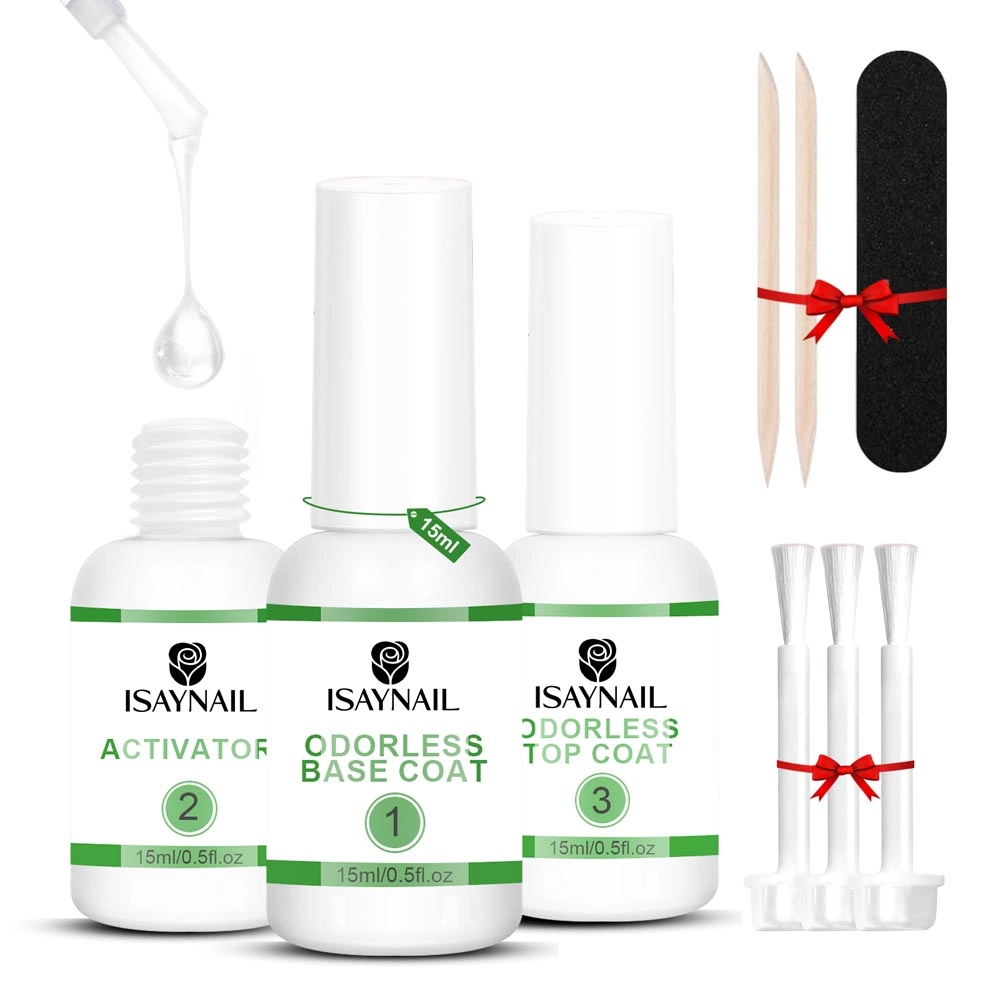
Essential Dip Powder Liquid Set 15ml Top Coat and Base Coat Gel Polish Kit

Professional Nail Supplier High Pigment Sparkly Shiny Laser Glitter Top Coat Gel
ISAYNAIL presents our High Quality Laser Rainbow Top Coat Gel Polish. Achieve a dazzling, colorful, and shiny glitter finish that mesmerizes. This long-lasting Laser Rainbow Top Coat elevates any manicure into a brilliant, eye-catching work of art. Experience the sparkle!

Clear Color 10ml Soak Off UV Lamp Top Base Coat Gel Polish Set

High Quality Soak Off UV LED Base Coat and Top Coat Gel Polish Set
Contact Us
We are committed to producing the best quality products at the most competitive prices.Therefore, we sincerely invite all interested companies to contact us for more information.
* Rest assured that your privacy is important to us, and all information provided will be handled with the utmost confidentiality.
Copyright © 2025 ISAYNAIL All Rights Reserved.
Isaynail
2in1_acrylic_powder.factory